Models and Culture
A Western model of leadership, whatever it may be, may not work effectively in developing countries. Likewise, leadership takes on a profoundly different configuration when observed in a multinational corporation in Chicago or among a group of young Afghan women seeking first and foremost to assert a gender identity that can then pave the way for the potential of “female leadership.” I mention Afghanistan because of my direct experience in International Development, but we know that this issue applies to countless other contexts.
Nor should we overlook all those cases in which a leader takes on characteristics resulting from the imitation of cultural models profoundly different from those of the country in which they operate. Those who lead must necessarily take into account the cultural context in which they are immersed, avoiding harm to the community and betraying the deeper meaning of leadership itself: guidance as an ethical function intended to foster collective growth that is conscious and attentive to the needs of new generations. Leadership is the responsibility to do well, for the benefit of those who will come after us (this is the theme of “legacy”).
Listening and Adaptability
In our collective imagination, we have built a concept of leadership based on what I would call a presumptuous prejudice: a leader is necessarily a winner. In doing so, we have equated “leadership” with an ego-driven and self-referential dimension of an individual capable of embodying a series of outward symbolic elements that can be projected to the public. But this dimension is destined to become obsolete.
Personally, I see the characteristics of leadership today in “an individual who listens.” From an initial condition in which the leader aspires to implement every possible strategy to consolidate power and notoriety (someone “to be known”), there is a progressive transition towards building a relationship of reciprocity, serious commitment and trust with one’s audience (someone “to be trusted”). The true leader absorbs, learns, listens and changes adaptively in response to the context and the input that comes from it.
The leader thus rises to an individual dimension capable of interpreting change and conveying to the community a message, a behavior, an approach—to thinking or to doing—that is accessible to most. I believe we cannot speak of leadership unless it becomes a “shared good,” participated in by a community of individuals. The leader is no longer merely a voice for themselves, but a voice that tells the story of many. The leader is no longer “someone apart from us”; we recognize the leader because they are part of our identity.
Observation and Authentic Knowledge
Leadership develops through the ability to engage in dialogue and to reconnect with an inner dimension that is often lost. We are protagonists in an evolutionary process in which our rationality has gradually been made increasingly distant from emotion. The progressive separation, and consequent lack of dialogue, between the rational and the emotional-sensory dimensions has led to a compression of the creative sphere.
Those capable of leadership—and who are also its guardians—possess the talent for observation, critical elaboration and the redefinition of processes and paths, even those consolidated through use or the certainty of habit. The leader promotes an original and unique dynamic in which thought and action are nourished by words, images, signs, combinations, associations, sounds, smells and tastes.
The sensory sphere of the many manifestations of existence can be understood only and exclusively if the close relationship between the rational and emotional dimensions is fully re-established. True power, therefore, lies in intuition.
Consider the figure of the leader in the civilizations of the past, those that carry within them an ancestral component to which we still belong, although it now seems to have been forgotten. The leader is the wise person. The wise person is one who knows. And yet, knowledge as such already stands on a lower plane than wisdom. In contemporary society, knowledge has been replaced by data. Data that are often fragmented: they provide information, but do not necessarily provide answers. And even when answers are provided, they are sometimes not sufficiently critical—in the sense of “judgment”—to be capable of generating wisdom.
We therefore need to learn how to reconnect.
Inner-Self and Intimacy
For a moment, let us step outside the language of everyday life, where the term “connection” has acquired a predominantly technological connotation, and reclaim its original meaning. Our inner-self rediscovers a form of dialogue with the inner-self of those who are “other than us.” Of course, this also happens through technology, but not through technology alone. Leadership is the recovery of a lost language that reaches a level of “intimacy” with the other and speaks of “trust.”
In this way, we can positively overturn the belief that the leader is, by definition, the winner. From this new perspective, a leader is someone who, having nurtured an authentic empathetic dimension over time, becomes capable of managing defeat as well. Only sincere self-awareness can shape the leadership of tomorrow: people capable of leading true transformation while keeping alive, at all times, a sense of wonder.
Credits
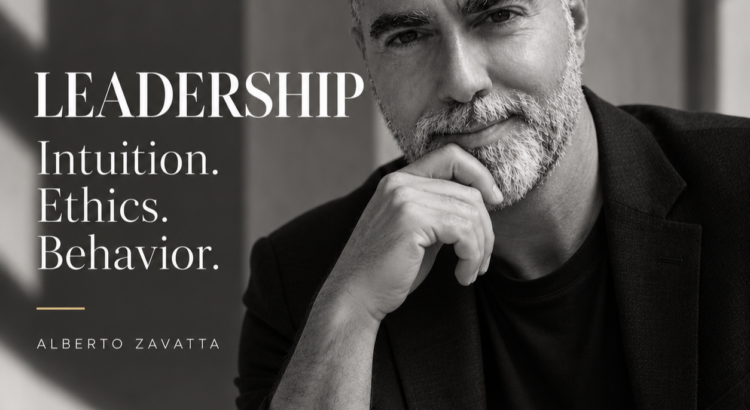
The article “LEADERSHIP: INTUITION, ETHICS AND BEHAVIOR” by Alberto Zavatta contributed to the development of the handbook published by Il Sole 24 Ore, “[First] Do Not Command” (“[Primo] non comandare”), by Pierangelo Soldavini, Francesco Pagano and Natalia Borri.
The book brings together opinions and ideas collected during the journey of CEO Confidential, a multimedia project that resulted in a series of 45 video interviews on sole24ore.com, featuring some of the freshest and most distinctive voices of our time: CEOs, start-up founders and personalities from Italy and abroad who are bringing change to companies and organizations across its different dimensions: sustainability, leadership, digital transformation and new tech.